Tuesday, February 4, 2014

Growth of Income Inequality Blocks Recovery

http://talkingunion.wordpress.com/2013/02/26/growth-of-income-inequality-blocks-recovery/
Portside Date:
February 26, 2013
Author:
JACK RAMUS
Date of Source:
Tuesday, February 26, 2013
Talking Union
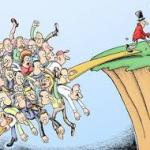

The dominant characteristic of the US economy today—and a fundamental cause of the faltering, stop-go economic recovery in the U.S. since 2009—is the long term and continuing growth of income inequality in America.

Income inequality in the US is not only growing, but growing at an accelerating rate. What follows is a detailed accounting of the dimensions of the growing income inequality in the US, and some of the more important reasons for that continuing, and now accelerating, income shift. Growing income inequality—approaching now obscene levels—is not simply a ‘moral outrage’. It not only represents a gross violation of historically held American values or reasonable equality for all. It is a condition that has served, and continues to serve, as a major cause of the lack of sustained economic recovery in the US now for five years—as well as a major factor in explaining why the US continues today to drift toward another ‘double dip’ recession.


Median Real disposable household income has been declining steadily over the long term since 2000 and that decline has accelerated since 2008, at a rate between 1-2% per year. With consumption constituting 70% of the US economy, spending by 100 million wage earning households in the US (bottom 80%) has limped along based increasingly on debt spending, more credit card usage, more withdrawals from 401k and savings accounts, and more part time second job employment. Recent data show more than 50% of all 401k withdrawals, which are rising rapidly, are withdrawn just to pay monthly bills. Auto, student and installation debt continues to accelerate. Part time jobs have increased nearly five-fold since 2008. Meanwhile, corporations sit on more than $2 trillion in cash and justify their hoarding, instead of investing and creating jobs, referring to the lack of household consumption for their goods and services as main reason for their reluctance to invest and create jobs. The US economy limps along in a ‘stop-go’ trajectory, and most recently ‘stop’ instead of ‘go’ as government and business continue to cut spending.

The Wealthiest 1% Households Historic Income Gains

That inequality is most dramatically represented by the growth in the share of national income by the wealthiest 1% of households, on the one hand, and the decline in the share of national income for the bottom 80% and remaining 110 million plus US households, on the other—i.e. between those earning an average of $593,000 a year (top 1%) and those earning less than $118,000 a year (bottom 80%) with a median annual income of around $50,000.

With average annual incomes of $593,000 a year today, the wealthiest 1% of households in the U.S.—approximately 750,000 out of a total of more than 150 million families in the U.S.—receive about 24% of all income generated in the US every year, according to Nobel Prize winning economist, Joseph Stiglitz. That’s up from only 8% of total income in 1979. That’s a tripling of the wealthiest 1%’s annual share of total income over the last three decades since Ronald Reagan took office. Not since 1928, when the wealthiest 1% share of income reached 22%, has income inequality been as extreme as today. And income inequality continues to grow worse at an accelerating rate.

According to studies of IRS data by University of California economist, Emmanuel Saez, and others, during the Clinton years, 1993-2000, the wealthiest 1% households captured 45% of all the increase in US income growth. During the George W. Bush years, 2000-2008, they captured 65%. And in the latest year of available data, 2010, they captured 93%. So the top 1% recovered quickly from the recession. So did their corporations, from which the same 1% households obtain more than 90% of all their income in the form of capital gains, dividends, interest, rents, and other forms of ‘capital incomes’.

Corporate Profits and the 1%

Profits are the major conduit through which the wealthiest 1% incomes grow, redistributed to stockowners, bondholders, and senior executive managers in the form of capital incomes like capital gains, dividends, interest, rents, etc. And Corporate Profits have done extremely well the past three decades, since 2001 in particular, and especially since the Great Recession of 2007-09.

After three years of recession, by 2011 corporate profits in the US were higher than even in 2007 just before the Great Recession began, rising at the fastest rate in 31 years during the recession and immediately after in 2010-11.

Averaging an annual rate of increase of about 10% from 1948-2007, Pre-Tax Corporate profits virtually doubled from their recession 2008 low-point of $971 billion to $1.876 trillion by March 2011 less than a year and a half later—i.e. a level 28% higher than even their 2007 pre-recession record high of $1.460 trillion.

A subset of the $1.876 trillion, i.e. profits of the 500 largest US corporations, rose 243% in 2009-10 according to the Wall St. Journal. That’s 243% after averaging 10% a year during 1998-2007. Moreover, that 243% does not include profits of multinational US corporations hidden and sheltered in their offshore subsidiaries, which in 2012 were estimated at more than $1.4 trillion.

This record gain in pre-tax corporate profits since the onset of the economic crisis in 2007-08 was achieved not from the increased sale of goods and services, but from record profit margins from cost-cutting operations—i.e. by cutting jobs, by reducing wages, benefits, and hours of work, and by productivity gains pocketed by management and not shared with their workers. Profit margins since 2008, i.e. profits as a percent of operating costs, by 2011 thus attained the highest levels in more than 80 years.

Just as cost-cutting at the direct expense of workers has been the main factor in generating record pre-tax corporate profits, so too have Corporate After-Tax profits surged as a consequence of massive corporate tax cutting by governments at all levels, Federal as well as State and Local.

Major corporate tax cut legislation in 2004-05, new rules allowing faster depreciation write-offs (a form of tax cut), and disregard of enforcing the foreign profits tax under George W. Bush all resulted in a further surge in corporate after-tax profits in Bush’s second term, 2004-08. That was followed by hundreds of billions more in business tax cuts at the Federal level under Bush and Obama from 2008 through 2012.

State and local government taxes on business since 2008 have been falling especially fast, as a December 1, 2012 feature article by Louis Story in the New York Times abundantly pointed out. That article estimated the cost of business tax cuts to by State and Local governments at no less than an additional $70 billion a year not represented in the above profits figures.

As a result of the continuing corporate tax cuts since 2008 at all levels of government, Corporate After-Tax profits recovered even faster during the recent recession than did pre-tax corporate profits. From a 2008 low-point of $746 billion, in less than 18 months from the recession low, after tax profits rose to $1.454 trillion—i.e. a level of 47% higher than even their 2007 pre-recession record of $989 billion. In other words, after tax profits recovered twice as fast as pre-tax profits as a direct consequence of government business tax cutting during the recent recession.

Corporate cost cutting at the direct expense of labor resulted in record corporate pre-tax profits during the last decade and especially since 2008. Three decades of corporate tax cutting—intensifying since 2001 and continuing through the recent recession—resulted in even greater after-tax profit gains. But as corporate tax cutting has intensified so too has the cutting of taxes on recipients of capital incomes—i.e. capital gains, dividends, interest, rents, etc.

The Personal Income Tax has concurrently been reduced for the wealthiest 1% households, enabling the ‘pass through’ of ever larger magnitudes of corporate after-tax profits to the wealthiest 1% and permitting that 1% to retain ever greater amounts of those distributed corporate profits as a result of accompanying reductions in the personal income tax.

The reductions in the Personal Income Tax have occurred in various forms: the lowering of the top marginal tax rates, the raising of the income threshold at which the top marginal rates would apply, the reducing of capital gains and dividends tax rates even faster than for other forms of income of the wealthiest 1%, introduction of new forms of interest income taxed at lowest rates (e.g. carried interest), the IRS benign neglect of offshore tax sheltering by the wealthy, the proliferation of countless income tax loopholes benefiting the wealthy too numerous to recount.

The outcome has been the shift in income to the top 1%, from 8% in 1979 to the estimated 24% share of national income in 2012, and the accelerating accrual of all income gains by the top 1% noted previously in the opening paragraphs of this essay.

Income Decline for the Bottom 80%

But income inequality is a consequence not only of income shifting to the wealthiest households and their corporations. Income inequality is a ‘double edged’ sword. It is also the consequence of conditions and policies which have simultaneously reduced the real incomes of the bottom 80% households—i.e. those 110 million earning less than $118,000 annual income and most of whom earn less than $50,000—while simultaneously raising the incomes of the wealthiest and their corporations. Once again the nexus is Corporate America.

Policies and measures that have raised corporate profits in the US to record levels over the past three decades, and especially since 2001, are in many instances the same policies that have reduced income for the middle and working classes in America. A short list of the major causes would include:

De-unionization of much of the labor force and a consequent collapse in the union-nonunion wage differential Free trade policies that have lowered wages for new export companies by 20% compared to higher paid jobs lost to imports. Millions of jobs permanently lost to free trade from NAFTA, CAFTA, and others Offshoring of high paying jobs by multinational corporations to Asia and beyond Creation of a 40 million two-tier workforce of part time and temp workers, with 60% wages and virtually no benefits Elimination of health care benefits for tens of millions, and reduction in benefit coverage and higher cost sharing for those remaining with benefits Longer duration between adjustments of minimum wage legislation, and smaller progressive adjustments when they occur Rising base level of unemployed as recessions occur more frequently, are deeper and longer in duration, resulting in job recovery longer and at lower pay Management hoarding of all productivity gains without sharing in part with wages Elimination of defined benefit pensions and replacement with minimal 401k plans Exemption by government rule changes of millions of workers from eligibility for overtime pay Rise in property tax, sales taxes, and other local government fees and charges as local government grants more and more tax cuts to corporations and businesses. Indexation and rise in payroll tax contributions by workers Reduction in paid leave time for vacations, holidays, sick leave, etc.

These and scores of other measures have resulted in a concurrent decline in working and middle class income, as profits of Corporations and income from capital simultaneously have risen. The heaviest impact has been on working class households earning annual income from $39,000 to $118,000 a year—virtually all of which is wage income—sometimes called the middle class.

According to the PEW Institute’s 2012 study, the share of total income for those households in that annual income range declined from 58% in 1983 to 45% in 2011. So what the top 1% households gained (16% share increase, from 8% to 24%), the middle class largely lost (13% share decline from 58% to 45%). In terms of wealth estimates, the middle class has lost 28% of its wealth in just the last two decades, whereas the top1% share of wealth has risen from 27% to 40%. The size of the middle class itself has declined, shrinking from 61% of adults in the US population at its peak to only 51% today.

The decline in income and wealth has been long term, increasing noticeably since 1980, accelerating since 2001, and continuing through the recent recession to the present day. Since 2008, households without a 4 year college education have been especially hard hit, with a significant -9.3% income decline at the median in less than four years. Older workers, age 55-64, and younger workers, age 25-34, have been similarly hard hit in terms of income decline; the former a -9.7% drop and latter a -8.9% drop. Even college degreed workers’ income has fallen by -5.9% since the so-called end of the recent recession in June 2009.

While some of the income decline is due to wage and benefit reductions by those who did not lose their jobs during the recent recession, much more of the relative income decline has been due to massive loss of jobs since 2007, which reached a level of 27 million at one point and still remain at 22 million after four years of so-called recovery. While more than 15 million jobs were lost, no more than 5 million have been ‘recovered’ since the recession began. Moreover, the jobs added during the recession have paid significantly less than the jobs lost, thus lowering income accordingly. According to a National Employment Law Project survey published in August 2012, 60% of the jobs lost during the recession were higher paying construction, manufacturing, and tech jobs, ranging between $13.84-$21.13 per hour. But only 22% of the jobs added since 2008 were in this range. In contrast, 21% of the jobs lost after 2008 were low paying, $7.69-$13.84, but the latter have been 58% of the jobs added during the recession. And the problem is not only short term and recession related. Since 2001, low wage jobs have grown 8.7% while higher wage jobs have decline -7.3%.

In summary, while corporate profits have continued to grow so too has the income of the top 1 wealthiest households. This has been made possible in large part at the expense of the middle and working classes, as rising corporate profits gained at workers’ expense are passed through to forms of capital incomes—the latter process accelerated by the reduction in both corporate taxation and personal income taxation for the wealthiest 1% households. The process began in earnest more than three decades ago under Reagan, continued under Clinton, accelerated under George W. Bush, and has remained under Obama during his first term. The consequence has been the growing—and accelerating—income inequality in America which is a major characteristic of the US economy in the 21st century.

It also explains in large part why the current US economic recovery has repeatedly relapsed on three different occasions since the formal end of the recession in June 2009, and will continue to do so in the future. While corporations, bankers, speculators, stock and bond traders, and the wealthiest households continue to experience significant long term income gains and have recovered years ago from the 2007-09 economic contraction, the rest of the populace remains plagued by an economy that has been simply ‘bouncing along the bottom’ now for four years.

Dr. Jack Rasmus is the author of the 2012 book, “Obama’s Economy: Recovery for the Few”, published by Palgrave-Macmillan and Pluto press. His website is: www.kyklosproductions.com;[1] his blog is: jackrasmus.com; and he can be reached on twitter at @drjackrasmus. The above is an excerpt from his forthcoming, March 2013 ‘Z’ Magazine article, ‘Income Inequality and Double Dip Recession’. For a complete version, see ‘Z’ Magazine.

[Thanks to the author for sending this to Portside.]


Monday, February 3, 2014

A Recent Coke Commercial Played America The Beautiful In Various Languages. Butthurt Ensued.


Science Is Hard: Global Warming Might Be Like, Global Weirding

Climate Change Might Just Be Driving the Historic Cold Snap

Climate change skeptics are pointing to the record cold weather as evidence that the globe isn't warming. But it could be that melting Arctic ice is making sudden cold snaps more likely—not less
It’s polar bear weather today for much of the Midwest. Temperatures are in the -20sº F (-28º C) and -30sº F (-35º C) in eastern Montana, North Dakota, northeast South Dakota, Minnesota and northern Iowa. With the stiff wind, it’s even worse—wind chills in the -40sº F (-40º C) and -50sº F (-45º C) are common across Minnesota and North Dakota, cold enough for exposed skin to suffer frostbite in just five minutes. By tonight, the freeze will reach the East Coast, where temperatures from Florida to Maine are expected to be 30º F to 40º F (16º C to 22º C) degrees below normal, extremes that haven’t been seen in decades. The National Weather Service isn’t kidding when it calls the cold “life-threatening.”
Unsurprisingly, the extreme cold has brought out the climate change skeptics, who point to the freeze and the recent snowstorms and say, essentially, “nyah-nyah.” Now this is where I would usually point to the fact that the occasional cold snap—even one as extreme as much of the U.S. is experiencing now—doesn’t change the overall trajectory of a warming planet. Weather is what happens in the atmosphere day to day; climate is how the atmosphere behaves over long periods of time. Winters in the U.S. have been warming steadily over the past century, and even faster in recent decades, so it would take more than a few sub-zero days to cancel that out.
But not only does the cold spell not disprove climate change, it may well be that global warming could be making the occasional bout of extreme cold weather in the U.S. even more likely.
Read more: Polar Vortex: Climate Change Could Be the Cause of Record Cold Weather | TIME.com http://science.time.com/2014/01/06/climate-change-driving-cold-weather/#ixzz2sJg8ix9Y

Often, throughout history, scientific fact has gone against what passed for common sense. Sometimes the debate about climate change brings to mind the undoubtedly interesting arguments that used to occur between flat earthers and learned peeps.

As early as the sixth century B.C., Pythagoras — and later Aristotle and Euclid — wrote about the Earth as a sphere. Ptolemy wrote “Geography” at the height of the Roman Empire, 1,300 years beforeColumbus sailed, and considered the idea of a round planet as fact.
“Geography” became a standard reference, and Columbus himselfowned a copy. For him, the big question was not the shape of the Earth but the size of the ocean he wanted to cross.
During the early Middle Ages, it is true that many Europeans succumbed to rumor and started believing that they lived on a flat Earth.

But Islamic countries knew better and preserved the Greek learning. By the late Middle Ages, Europe had caught up and in some cases surpassed the knowledge of ancient Greece and medieval Islam.

Friday, January 31, 2014

Millions Are Now Realizing They're Too Poor For Obamacare

Many states, mostly in the South, refused to expand Medicaid. Not only is this causing millions of Americans to not have insurance coverage, and imperiling their health, but it is costing taxpayers living in those states millions of dollars. This is an outrage.

Obamacare was supposed to make health coverage affordable, or even free, for low-income Americans. The law's official name is the Affordable Care Act. However, the Supreme Court tossed a huge obstacle in the path of that goal in 2012, ruling that the states could opt out of one of Obamacare's crucial provisions: The expansion of Medicaid coverage to anyone making less than 133 percent of the federal poverty level, or about $15,300 a year for a single person. Since the court's ruling, 24 states, including Florida, chose not to expand the program.
Under the pre-Obamacare rules, eligibility for the program typically was limited to low-income children, pregnant women, parents caring for children at home, and adults with disabilities. Without the law's expansion, an adult without a disability who isn't living with their children -- like Alphonse -- doesn't qualify for Medicaid, no matter how poor he or she is.
For those who don't qualify for Medicaid coverage, Obamacare offers tax credits for private health plans sold through the law's health insurance exchange marketplaces. But those subsidies are available only to those making between the poverty level, or about $11,500 for an individual, and four times that amount. In states not expanding Medicaid, people who earn less than poverty wages get nothing.
Moar here.

Monday, January 27, 2014

Confessions of a Former Libertarian: My Personal, Psychological and Intellectual Epiphany

I was a Buddhist concerned with world suffering — and I could no longer reconcile my humanity with my ideology.

Moar here.

Why Does Hating Other Religions Seem Fundamental to a Religion?

There are some 10,000 different religions, and followers of each are convinced that they possess the one truth.

As far as I’m concerned, the most interesting question about religion isn’t whether God exists but why so many people are religious. There are around 10,000 different religions, each of which is convinced that there’s only one Truth and that they alone possess it. Hating people with a different faith seems to be part of belief. Around the year 1500, the church reformer Martin Luther described Jews as a “brood of vipers.” Over the centuries the Christian hatred of the Jews led to pogroms and ultimately made the Holocaust possible. In 1947, over a million people were slaughtered when British India was partitioned into India for the Hindus and Pakistan for the Muslims. Nor has interfaith hatred diminished since then. Since the year 2000, 43 percent of civil wars have been of a religious nature.

Moar here.

The 20 Richest Americans Are Greedy Takers—Not Inspirational 'Makers'

They have all taken from the public or from employees, or through taxes or untaxed inheritances.

The top individuals on the 2013 Forbes 400 list are generally believed to be makers of great companies or concepts. They are the role models of Paul Ryan, who laments, "We're going to a majority of takers versus makers in America." They are defended by Cato Institute CEO John A. Allison IV, who once protested: "Instead of an attack on the 1 percent, let's call it an attack on the very productive." 

But many of the richest Americans are takers. The top twenty, with a total net worth of almost two-thirds of a trillion dollars, have all taken from the public or from employees, or through taxes or untaxed inheritances. 

Moar here.

Obama Is Driving The Right Literally, Not Figuratively, Insane

Obama Derangement Syndrome is rapidly devolving into Obama Psychosis. There is now almost nothing the right won’t blame on Obama. Chris Christie broke the law? OBAMA! Fox News ratings dropped a bit? OBAMA! Rush Limbaugh getting dropped from dozens of large markets? OBAMA!!!!

I know Obama Derangement Syndrome, but what the heck is Obama Psychosis?

Obama Psychosis: A total loss of contact with reality that usually includes: False beliefs about who President Obama is and what he is doing (delusions); Seeing or hearing things that President Obama never did or said (hallucinations).
Obama Psychosis Exhibit #1: Dinesh D’Souza, a minor celebrity on the right for an anti-Obama movie, picked the wrong people to help him break campaign finance laws and is now in trouble. No one forced him to break the law. He was not tricked. He was not entrapped. But add a little Obama Psychosis and BOOM! D’Souza is a victim of a nefarious plot.
Moar here.

Wednesday, January 22, 2014

Cold Snap For US? It’s the Global Warming-Induced COLLAPSING Polar Vortex, Stupid

"Disruptions of the polar vortex have been predicted by climate scientists such as Dr. Jennifer Francis, Dr. James Hansen, and Dr. Jeff Masters, among others, who have warned of more extreme weather caused by, among other things, loss of polar sea ice. Dr. Hansen, in particular, has warned of very intense storms as Arctic melt continues to ramp up and more of the Arctic’s cold is pushed episodically southward where it will inevitably confront the warming temperate and tropical zones. In the end, Hansen warns of frontal systems packing the strength of hurricanes large enough to span entire continents. These are the powerful effects of continued Arctic warming and of which the current polar vortex collapse is but a symptom."

Yeah, wait until this happens a few times. The flat earthers will be screaming that it's either God's judgement for marriage equality of just a crazy fluke that could possibly happen again. Or a third time. Nope, four times isn't a pattern. Five times? Pure coincidence. Six times? It's perfectly normal, what are you talking about? We've always been at war with Eurasia! ~ Justin Rosario


Moar here.

Did Syria Gas It's Civvies, Or Was It The Rebels?

Read it here.

How US Pressure Bends UN Agencies

More on Bush lied, hundreds of thousands died:

Bolton, a blunt-speaking neocon who later became Bush’s Ambassador to the United Nations, continued to insist in a recent interview with the New York Times that Bustani was ousted for incompetence. But Bustani and other diplomats close to the case reported that Bustani’s real offense was drawing Iraq into acceptance of the OPCW’s conventions for eliminating chemical weapons, just as the Bush administration was planning to pin its propaganda campaign for invading Iraq on the country’s alleged secret stockpile of WMD.

Bustani’s ouster gave President Bush a clearer path to the invasion by letting him frighten the American people about the prospects of Iraq sharing its chemical weapons and possibly a nuclear bomb with al-Qaeda terrorists.

Brushing aside Iraq’s insistence that it had destroyed its chemical weapons and didn’t have a nuclear weapons project, Bush launched the invasion in March 2003, only for the world to discover later that the Iraqi government was telling the truth. As a result of the Iraq War, hundreds of thousands of Iraqis have died, along with nearly 4,500 American soldiers, with the estimated costs to the U.S. taxpayers running into the trillions of dollars.

Moar here.

Monday, January 20, 2014

Fox News host: Solution to high minority arrest rate is for them to smoke less pot

Today on Fox News we learn that if minorities don't like being arrested so much, they should smoke less ‪#‎marijuana‬.


http://www.rawstory.com/rs/2014/01/20/fox-news-host-solution-to-high-minority-arrest-rate-is-for-them-to-smoke-less-pot/

Tuesday, January 7, 2014

Noam Chomsky: The drug war is the latest manifestation of a centuries-old ‘race war’

When looking at America's Horrific War On Drugs™, one has to consider what were the objectives and have we met them.

From a law enforcement perspective, our responsibility is to disrupt, dismantle, and destroy drug trafficking enterprises. We must also reduce the demand for drugs... Here.

That's the most succinct statement of objectives I could find. So, have we met these objectives? 

The world's most extensive study of the drug trade has just been published in the medical journal BMJ Open, providing the first "global snapshot" of four decades of the war on drugs. You can already guess the result. The war on drugs could not have been a bigger failure. To sum up their most important findings, the average purity of heroin and cocaine have increased, respectively, 60 percent and 11 percent between 1990 and 2007. Cannabis purity is up a whopping 161 percent over that same time. Not only are drugs way purer than ever, they're also way, way cheaper. Coke is on an 80 percent discount from 1990, heroin 81 percent, cannabis 86 percent. After a trillion dollars spent on the drug war, now is the greatest time in history to get high.

The new study only confirms what has been well-established for a decade at least, that trying to attack the drug supply is more or less pointless. The real question is demand, trying to mitigate its disastrous social consequences and treating the desire for drugs as a medical condition rather than as a moral failure.

But there's another question about demand that the research from BMJ Open poses. Why is there so much of it? No drug dealer ever worries about demand. Ever. The hunger for illegal drugs in America is assumed to be limitless. Why? One answer is that drugs feed a human despair that is equally limitless. And there is plenty of despair, no doubt. But the question becomes more complicated when you consider how many people are drugging themselves legally. In 2010 the CDC found that 48 percent of Americans used prescription drugs, 31 percent were taking two or more, and 11 percent were taking five or more. Two of the most common prescription drugs were stimulants, for adolescents, and anti-depressants, for middle-aged Americans.

Both the legal and illegal alteration of consciousness is at an all-time high. And it is quickly accelerating. 

Read more: The War on Drugs Is Over. Drugs Won. - Esquire 
Follow us: @Esquiremag on Twitter | Esquire on Facebook 
Visit us at Esquire.com


Since Richard Nixon declared war on drugs in 1971, the United States has followed down a policy path which dramatically increased the size of federal drug control agencies, the incarceration of non-violent drug offenders, and the penalties for drug use. These policies have done little to stop drug use while also leading to a higher incarceration rate than any other country in the world through the imprisonment of non-violent drug offenders. Drugs are winning.

The drug war has failed us, even worse; it has harmed our country through its draconian policies. The tide is currently swaying towards legalization of marijuana, but that will not be enough to undue this systemic harm. It is time to stop the war on drugs and replace its policies with ones which are less egregiously unjust.

Read more: Policymic

By any standard I can apply, the answer to the question, "Have we met the objectives of our drug war?" is a big ol' NO!

The damage to American society caused by the drug war is best summed up by Noam Chomsky:

“If you take a look at the incarceration rate in the United States, around 1980 it was approximately the same as the rest of developed society. By now, it’s out of sight — it’s five-to-ten times as high as the rest of wealthy societies.”
“It’s not based on crime,” Chomsky continued. “The device that was used to recriminalize the black population was drugs. The drug wars are fraud — a total fraud. They have nothing to do with drugs, the price of drugs doesn’t change. What the drug war has succeeded in doing is to criminalize the poor. And the poor in the United States happen to be overwhelming black and Latino.”
Chomsky then made his most explosive statement, claiming that the war on drugs is, in fact, “a race war.”
“It’s a race war. Almost entirely, from the first moment, the orders given to the police as to how to deal with drugs were, ‘You don’t go into the suburbs and arrest the white stockbroker sniffing coke in the evening, but you do go into the ghettos, and if a kid has a joint in his pocket, you put him in jail.’ So it starts with police action, not the police themselves, but the orders given to them.”
“Then there’s the sentencing, which is grotesquely disproportionate — then the highly punitive system instituted after, if anybody ever gets out of prison.” He claimed that “[p]rison’s only about one thing: punishment. They only learn one thing in prison, which is how to be a criminal…and the result is like reinstating Jim Crow.”
Read more: Raw Story

Wednesday, January 1, 2014

Navy sailors have radiation sickness after Japan rescue

Navy sailor Lindsay Cooper knew something was wrong when billows of metallic-tasting snow began drifting over USS Ronald Reagan.
“I was standing on the flight deck, and we felt this warm gust of air, and, suddenly, it was snowing,” Cooper recalled of the day in March 2011 when she and scores of crewmates watched a sudden storm blow toward them from the tsunami-torn coast of Fukushima, Japan.
Modal Trigger
Lindsay Cooper
The tall 24-year-old with a winning smile didn’t know it then, but the snow was caused by the freezing Pacific air mixing with a plume of radioactive steam from the city’s shattered nuclear reactor.
Now, nearly three years after their deployment on a humanitarian mission to Japan’s ravaged coast, Cooper and scores of her fellow crew members on the aircraft carrier and a half-dozen other support ships are battling cancers, thyroid disease, uterine bleeding and other ailments.
“We joked about it: ‘Hey, it’s radioactive snow!’ ” Cooper recalled. “I took pictures and video.”
But now “my thyroid is so out of whack that I can lose 60 to 70 pounds in one month and then gain it back the next,” said Cooper, fighting tears. “My menstrual cycle lasts for six months at a time, and I cannot get pregnant. It’s ruined me.”
The fallout of those four days spent off the Fukushima coast has been tragic to many of the 5,000 sailors who were there.
At least 70 have been stricken with some form of radiation sickness, and of those, “at least half . . . are suffering from some form of cancer,” their lawyer, Paul Garner, told The Post Saturday.
“We’re seeing leukemia, testicular cancer and unremitting gynecological bleeding requiring transfusions and other intervention,” said Garner, who is representing 51 crew members suing the Tokyo Electric Power Co., which operates the Fukushima Daiichi energy plant.
“Then you have thyroid polyps, other thyroid diseases,” added Garner, who plans to file an amended lawsuit in federal court in San Diego next month that will bring the number of plaintiffs past 70.
Modal Trigger
Smoke rises from the crippled Fukushima Daiichi nuclear plant in March 2011 after it was hit by a tsunami.Photo: REUTERS/Tokyo Electric Power Co./Handout
Senior Chief Michael Sebourn, a radiation-decontamination officer, was assigned to test the aircraft carrier for radiation.
The levels were incredibly dangerous and at one point, the radiation in the air measured 300 times higher than what was considered safe, Sebourn told The Post.
Moar here.

TEPCO Quietly Admits Reactor 3 Could Be Melting Down NOW

Turner Radio Network (TRN) has issued a report regarding Fukushima Diachi Nuclear Plant that is expected to affect the entire Northern Hemisphere.

According to the report: “Persons residing on the west coast of North America should IMMEDIATELY begin preparing for another possible onslaught of dangerous atmospheric radiation from the Fukushima nuclear disaster site in Japan.”

Through ENENews reports, TEPCO has confirmed  via camera surveillance, that steam has begun to pour from Reactor 3, although they have “not been identified abnormal plant conditions.”

TEPCO are reporting that “radioactive steam has suddenly begun emanating from previously exploded nuclear reactor building #3 at the Fukuishima disaster site in Japan.”

The corporation is not clear on the details of the sudden change at Reactor 3 because of “lethal radiation levels in that building.”

Summations from experts conclude that this may “be the beginning of a ‘spent fuel pool criticality (meltdown)’ involving up to 89 TONS of nuclear fuel burning up into the atmosphere and heading to North America.”

- See more at: http://www.occupycorporatism.com/tepco-quietly-admits-reactor-3-melting-now/#sthash.VkAc09K3.dpuf


America’s Foreign Policy Challenges in the Middle East, 2014

Those who suggest that the United States as a superpower is weaker in the Middle East today than nine years ago overestimate the impact on the region of the Bush administration’s frenetic invasions and occupations. Iraq and Afghanistan were off in corners of the Middle East, and the US clearly got bogged down in them fairly quickly. If anything, many countries in the region, such as Syria, felt they benefited from the US quagmires in the sense that Washington was preoccupied elsewhere. Hosni Mubarak in Egypt also blew off Condi Rice’s demand that he democratize.
Still, it is certainly the case that the diplomatic and military relationship of the US to the region is changing.

Smuck Dynasty

Phil's sure been busy! Let's hop in the Evil Liberal Time Machine™ and take a look at back at 1998 for some MORE of Phil's bigotry--this time against Muslims, the Chinese, and indirectly the Japanese (since he thinks Shinto is a Chinese religion). ~ Republican Family Values

http://aattp.org/duck-dynasty-patriarch-hates-on-chinese-says-muslims-are-famous-for-murder-video/