URGENT APPEAL: Korea remains a tinderbox which could blow up at any minute, exactly as it did (after South Korean military provocations) in June of 1950. We must inform people and raise a protest, beginning with the peace movement and Left who seem clueless on this issue. Please contact http://www.endthekoreanwar.org/ and please, post and to pass on this article so that the information goes beyond my small (if select) circle of friends.
The Korean Powder Keg II
Why is the Obama Administration, bogged down in the Iraqi and Afghani quagmires, still playing ‘chicken’ with a trigger-happy nuclear-armed North Korean regime? Far from allowing the crisis following last month’s deadly artillery duel to die down, the U.S. and South Korea have ratcheted up the saber-rattling, extending the massive mobilization of their troops for a prolonged live fire military ‘games’ deliberately designed ‘to effectively deter North Korean aggression and strengthen the joint capabilities to respond.’ (This according to a Dec. 7 joint statement by South Korean Chief of Staff Han and his U.S. counterpart, Admiral Mike Mullen.)[1]
Escalating Threats
More frightening still are the recent statements by South Korea’s new, far-right defense secretary Kim Kwan-jin, who threatens to launch South Korean air-strikes at the slightest N. Korean provocation.[2] The appointment of the bellicose Kim represents a sudden and dramatic revolution in South Korean military strategy.[3] Korean policy has been hardening since the 2008 election of hawkish President Lee, who scrapped his predecessor’s President Roh’s conciliatory ‘Sunshine Policy’ (under which South Koreans were able to communicate with family members in the North for the first time in 60 years).
The South Korean electorate, haunted by memories of the bloody 1950-53 War, has long been anti-militarist, content to bask in their increasing prosperity and let the N. Koreans rattle their cage from time to time over the years. ‘North Korea has nothing to lose, while we have everything to lose’ explained a professor of politics at Seoul National University recently quoted in the N.Y. Times. Now, in a striking reversal, we have trigger-happy Defense Minister Kim, backed by Admiral Mike Mullen and his atomic fleet, publicly declaring his policy of giving ‘more authority to commanders in the field’ including to ‘shoot first’ (in the case of aerial dogfights). According to a senior South Korean military analyst quoted in the Times,‘the new rules of engagement would also allow pre-emptive strikes on the North if there are indications of a possible attack. . .’ Given the North’s superior ground power, the South Koreans will rely on “using the air force is a way of balancing the power in the region.”
Possible Consequences of Miscalculation
The slightest miscalculation on the part of trigger-happy South Korean officers or their paranoid-for-a-reason North Korean counterparts could re-ignite the still-unresolved 1950-1953 Korean conflict, involving South Korea and the U.S. in an Asian land-war of major proportions with a military power whose nuclear umbrella (and alliance with China) would preclude the use of U.S. nuclear might. Far from backing down in the face of U.S. posturing, the North Koreans, like the North Vietnamese forty years ago, know they are in a position reduce America to what a desperate Nixon called a ‘helpless giant.’ They are confident of prevailing and, like the North Vietnamese Communists before them, they are prepared to pay the price of such a ‘victory.’
As we noted last week, (see ‘The Korean Powder-Keg I’ attached below), North Korea’s deliberate lethal shelling of a costal island, following upon the sensational revelation of her new, advanced atomic facilities, were not ‘irrational’ outbursts, much less pointless, isolated ‘provocations,’ but a carefully calculated responses to massive U.S./South Korean ‘live-fire’ military exercises carried out in disputed coastal waters in the context of an aggressive U.S. policy openly aimed at the DPRK’s overthrow as a ‘terrorist state’ (the Axis of Evil) and ‘regime change.’
Does Washington have a Strategy?
Is there any geo-political strategy behind these bellicose imperialist posturings? Apparently South Korea’s hawkish new President and the clueless Obama Administration, have been ratcheting up the tension in the mistaken belief that increasing outside pressure will somehow cause the rigid Stalinist regime to crack, with U.S. and South Korean troops being greeted as liberators by N. Korean maidens holding flowers. However, historical experience indicates that outside pressure only serves to harden national feeling (London under the blitz, N. Vietnam under the B-52’s) and to strengthen dictatorial regimes (from Hitler’s to Castro’s). In 2003 Bush and Cheney dreamed up and then stage-managed such a ‘liberation’ in Baghdad (famously faking the toppling of Saddam’s statue) with disastrous long term results for U.S. power and prestige. But at least the Bushies had the excuse of Far-Right ideology, native stupidity and self-imposed ignorance.
No doubt Bush holdover Gates still harbors such illusions concerning the ‘liberation’ North Korea, but our wonk of a President and his sophisticated Secretary of State have also been advised by former President and Special Envoy Jimmy Carter, a former Ambassador to S. Vietnam, intelligence experts and veterans of the Bill Clinton State Department (which negotiated a treaty with N. Korea in 1999 but at the last minute failed to sign it). They know perfectly well that the North Koreans sincerely want peace and will reliably give up nukes for diplomatic recognition and a treaty to end the State of War which the U.S. continues to impose on them.[4] Yet the Obama Administration has made a point of refusing to talk with the DPRK, even in the context of the six-partite regional peace forum sponsored by the Chinese.
The China Factor
Clearly, much of this U.S. naval muscle-flexing is aimed at the Chinese, who naturally consider as part of their sphere of influence the South China Sea, with claimed coastal waters extending 200 miles out into the gulf. The Chinese can only view the presence of a huge naval armada in their private lake the way Americans would view a Russian fleet headed by the nuclear aircraft carrier V.I. Lenin steaming into the Gulf of Mexico to conduct joint live-fire exercises with Castro’s Cuba, including an amphibious landing in Mexico. The explicit purpose of this show of fore, according to U.S. Chief of Staff Admiral Mike Mullen, is to pressure the Chinese to take a public stand condemning the North Koreans.[5]
China’s official position, in its peacemaking role as the major regional power, is to invite the U.S. back to the six-party talks it is sponsoring – talks which the Obama Administration is for some obscure reason boycotting. For China to condemn North Korea under the threat of U.S. naval pressure in her coastal waters would be an unthinkable loss of face, a betrayal of the 60-year alliance between the two Asian Communist neighbors, and an abject submission to U.S. imperialism. Highly unlikely.
Gunboat Diplomacy
So why is Obama playing Teddy Roosevelt style gunboat diplomacy in the South China Sea, signaling an abrupt rupture in America’s peaceful relation with China, the U.S.’s biggest economic partner and its major creditor? Can’t Obama see that the rising, nuclear-armed Asian superpower will be harder to intimidate than Nicaragua? What is the pressing geo-strategic advantage of risking a major break with China and involvement in another land war in Asia over the North Koreans, who are basically rattling their cage in order to get the U.S. to talk to them? Why are the Americans, who failed to win the first Korean War, were beaten in Vietnam, and are now quagmired in Muslim West Asia, once again acting out John Wayne at the Alamo, this time with Obama as an unlikely Davy Crockett and N. Korea’s Kim Jing il in the role of the Mexican General Santa Ana?[6]
The short answer is this: after 60 years U.S. imperialism is still unwilling to admit it lost the Korean War, beaten by an Asian people and forced to withdraw because U.S. public opinion would no longer sustain it. The ‘Korea syndrome’ was the grandfather of the ‘Vietnam syndrome,’ and U.S. imperialism, like a macho who is worried about sexual impotence, keeps trying obsessively to ‘prove himself’ after each failure. Indeed, ‘getting over’ the Vietnam syndrome was one of the Bush Administrations avowed aims in invading Iraq.
The roots of the ‘long answer’ go back to the origins of the Cold War and the ‘Hidden History of the Korean War’, which my boyhood hero I.F. Stone was the first to reveal. I explore these roots in my next article. Meanwhile, don’t forget to click onhttp://www.endthekoreanwar.org/ and to pass on this article to others.
Comments always welcome.
Cordially, Richard Greeman
Montpellier, France
Sunday, December 12, 2010
The Korean Powder Keg
North Korea is a powder keg, and the Obama Administration -- like the Bush Administration whose bellicose policies it inherited -- is playing with matches. Why are the U.S. and its allies hysterical about the Iranians -- whose nuclear programs might at some future time lead to nuclear weapons -- while recklessly provoking the North Koreans, whose stock of tested nuclear weapons are presumably operational now?
The Korean powder-keg is the kind of situation that calls for delicate diplomacy, yet the U.S. chose to send the atomic-powered aircraft carrier George Washington to join the provocative U.S./South Korean war-games in contested waters just off the coast of North Korea.[1] While the Administration and the media chose to focus on the fatal shelling of Yeonpyeong Island in order to portray the N. Koreans as homicidal maniacs, placed in the context of the U.S. imperialism’s far more aggressive and provocative behaviors, N. Korea’s brutal ‘signals’ may best understood as defensive.
Look at the facts from the N. Korean point of view.
Under the pretext of ‘live-fire’ war games, the U.S./S.Korean command assembled a huge armada including the 31st Marine Expeditionary Unit and the 7th Air Force in the South China Sea where U.S. and South Korean marines planned to stage a combined amphibious landing exercise. This was to take place on the west coast of Korea a few miles from Inchon, where, as every Korean school-child knows, in June 1950 Gen. MacArthur pulled off his historic amphibious invasion of in and set out to conquer the North. The N. Koreans had every reason to fear that history will repeat itself, given that such maneuvers have often been preludes to war (as in Europe in 1914).
Moreover, North Korean schoolchildren (not to mention military leaders) are also painfully aware that sixty years after MacArthur’s invasion, the U.S. has still not made peace or recognized their government. Thus the most powerful nation on earth is still officially at war with their country and free to attack them without warning. Are their fears irrational? Let us recall that from the official U.S. point of view, the Korean conflict of 1950-1953 was not a “War” but a “Police Action,”[2] part of America’s self-appointed role as policeman of the world and leader of the anti-Communist crusade. Washington still considers itself the world’s policeman and has declared the Democratic Peoples’ Republic of Korea (DPRK) part of the ‘Axis of Evil’ -- placed on the U.S. agenda for Iraq-style ‘regime change’ (i.e. invasion and occupation).
Give Peace a Chance?
On the other hand, the goals of the legitimate (if repugnant) government of the DPRK are equally simple: As the N. Korean leadership has repeatedly stated, they would give up their nukes in return for diplomatic relations and a peace treaty ending the war.[3] Moreover, such promises have proven reliable in the past. [4]What is the U.S. counter-offer? The same one they gave to the Indians: turn in your weapons first, and trust the Great White Father in Washington to treat you fairly afterwards. A century ago in the Far West, the Apaches and the Comanches only had bows and a few rifles, but rather than submit to living death on the Reservation they chose to fight on. The Comanche of today’s Far East have a huge, modern mechanized army backed by nukes. It is unlikely that they will submit, and if they feel threatened they will not hesitate to attack first, as they have proven in the past.
The deliberately lethal N. Korean shellings of last week and their deliberate revelation of new, more advanced nuclear facilities were designed to convince Obama and the South Koreans they mean business.[5] It would be sheer madness to call their bluff when, to quote Lennon, ‘All they are saying is give peace a chance.’ Yet, Washington, apparently still obsessed with America’s John Wayne image as hard-nosed Indian-fighter and implacable Sheriff of the world, adamantly refuses to negotiate and insists on playing ‘chicken’ with an adversary who has much less to lose and is therefore unlikely to blink first. If the DPRK is pushed too far and decides to attack, what might happen next?
A New Korean War?
The 1950-53 Korean Conflict between a United Nations Police Force headed by the U.S. (including notably G.B. and Turkey) and the DPRK ended in a stalemate, with a Cease Fire and the creation of a narrow Demilitarized Zone dividing the two Koreas along the 38th Parallel. Along this Cease-Fire line, fortified on both sides, bloody skirmishes have been taking place for sixty years. Half of South Korea’s population is within 50 miles of North Korea’s arsenal of almost 12,000 artillery guns and rockets. Those weapons are ‘more than sufficient to destroy much of what South Korea has created in over half a century.’[6] Recently discovered were two North Korean infiltration tunnels: 2 meters wide, 2 meters high and 65 meters underground, capable of transporting 10,000 solders an hour right up to the outskirts of Seoul, South Korean capital. The existence of 15 other tunnels is suspected.
The North Korean army has 1,100,000 soldiers, well armed and well fed despite widespread shortages generally. North Korea is one of the poorest countries in the world, South Korea is one of the richest. The opportunity for North Korean troops to plunder the South, as they did in 1950, would relieve the North’s economic crisis and restore popularity to the dictatorial regime. If they feel threatened enough, the North Koreans are in a position to over-run South Korea in a matter of days, just like they did in 1950. And this time, they would be protected by a nuclear umbrella.
The North Korean government began its atomic program in the 1950s, constructed reactors in the 1960s and eventually succeeded in producing atomic weapons and in testing missiles to launch them. Military experts estimate that the DPRK has built 8 to 12 nuclear warheads, but they may have many more. In a situation where it will no longer have much to loose, the North Korean regime will not hesitate to use them. Assuming a 50% or even a 90% failure rate among their Soviet-era medium-range missiles, the North Koreans could still take out the U.S. fleet and obliterate Seoul and Tokyo. Would they dare?
North Korean generals have been cited explaining why Saddam lost the 1991 war: “Iraq lost because it stayed on the defensive. You must take the offensive. Iraq didn’t use all its weapons. If we are at war, we will use all of them. And if there is war, we must attack first, take the initiative.” There is nothing secret or ambiguous about official Peoples’ Army doctrine. Those were precisely the tactics of the North Korean army when it attacked on 25 June 1950 and succeeded in a few weeks in driving back the American and South Korean forces to the Sea of Japan.)
According to pundit Leslie Gelb, current U.S. policy is to let the South Koreans take the lead in this confrontation (‘after all, it is their country’) and South Korea’s aggressive President Lee has said he ‘would order military strikes on northern bases if Pyongyang seemed poised to launch further attacks’ while his new defense minister declared on Dec. 1 that the South would use air strikes against North Koreaif it carried out further attacks.[7] A land-based North Korean counter-attack would put the U.S. in an untenable position.
With its ground forces tied down in the Afghani and Iraqi quagmires, there is no way America could fight a land war in Asia, so U.S. war plans call for massive air attacks. On the other hand, the use of U.S. nukes so close to the Chinese border would have to be ruled out, unless Washington is willing to risk and open break with the Asian giant and the risk of thermonuclear war. Obama’s senseless provocation of a desperate, cornered enemy seems like a formula for disaster, but it wouldn’t be the first time in history belligerent countries blundered into war.
From the point of view of the objective self-interest of U.S. imperialism, it is difficult to imagine a positive outcome if the explosive Korean situation reaches the unknowable tipping point. Yet the Obama Administration, with Cheney’s twin Gates in charge of the Defense Department, continues to pursue Bush’s hysterical cowboy crusade against the Axis of Evil, escalating the pointless fighting in Afghanistan, not-so ‘secretly’ expanding the military conflict into Yemen and unstable, nuclear-armed Pakistan (Woah!) and now stirring up the North Korean nuclear hornet’s-nest. Why?
As we will show in our next article, the answer to that question is rooted in the history of the Cold War, indeed, precisely in the history of the Korean conflict, which is where the Cold War began (or rather turned hot). Meanwhile, readers should do everything possible to build opposition to a new Korean war before it is too late. Please click on http://www.endthekoreanwar.org/ Please feel free to post and to pass on this article.
P.S.
Victor Serge Foundation desperately seeks Webmaster/website designer familiar with Drupal to upgrade radical site. Movement wages. Please reply rgreeman@gmail.com

Friday, December 10, 2010
Clusters and Networks
David Brooks is an insufferable jackass. I have no use for his designation of 'cluster' and 'network' liberals. But he does come close to approximating the truth with this bit:
The flaw in our thinking isn't that we had no strategy for how to win the battle over tax cuts. I think the flaw might have been in focusing too exclusively on tax cuts and not enough on what waging that battle would cost in other areas, like getting unemployment insurance extended, getting the START treaty ratified, getting a continuing resolution, passing the Defense Authorization, and whatever else is on the must-do list during the lame duck. The president has to weigh everything, and he apparently made the calculation that fighting it out on the tax cuts had too much downside and too much uncertainty. I find that frustrating but he's not making easy decisions. I wouldn't trade the START treaty for millionaire's tax cuts, so I understand how difficult it is to put everything in proper balance.
On another point, I find it a bit disconcerting to find myself much more temperamentally aligned with Chuck Schumer than the president. Call me a cluster Democrat if you want, but I do basically see the Republicans as "the concentrated repositories of human evil." I don't see Dick Lugar or Olympia Snowe or Susan Collins or Lisa Murkowski that way. But they are almost irrelevant these days. Most incoming Republicans are petty criminals, paid to have stupid greedhead opinions, or genuinely so stupid as to not know they're supposed to be putting on a show. You negotiate with them because you have to, not because there is an intrinsic merit in it or because you get better policy that way.
Yet, in the universe of liberal opinion, I guess Brooks would call me a Network Democrat. But that is only because he is an idiot.

The big story of the week is that Obama is returning to first principles, re-establishing himself as a network liberal. This isn’t a move to the center or triangulation. It’s not the Clinton model or the Truman model or any of the other stale categories people are trying to impose on him. It’s standing at one spot in the political universe and trying to build temporarily alliances with people at other spots in the political universe.
You don’t have to abandon your principles to cut a deal. You just have to acknowledge that there are other people in the world and even a president doesn’t get to stamp his foot and have his way.
Cluster liberals in the House and the commentariat are angry. They have no strategy for how Obama could have better played his weak hand — with a coming Republican majority, an expiring tax law and several Democratic senators from red states insisting on extending all the cuts. They just sense the waning of their moment and are howling in protest.
They believe nonliberals are blackmailers or hostage-takers or the concentrated repositories of human evil, so, of course, they see coalition-building as collaboration. They are also convinced that Democrats should never start a negotiation because they will always end up losing in the end. (Perhaps psychologists can explain the interesting combination: intellectual self-confidence alongside a political inferiority complex).I think it is overstating the case to say that liberal critics had no strategy for how Obama could have done better. I believe our advice was to play chicken with the Republicans and take the tax cuts down to the moment before the ball drops in Times Square. If necessary, let them expire and make damn sure everyone in the country knows why their taxes went up. Yes, it would be damaging to the economy in the short-term and would probably rattle Wall Street a bit (as the White House warned Chuck Schumer). But it would be good politics and great for the budget deficit. And, the GOP would probably have backed down at some point.
The flaw in our thinking isn't that we had no strategy for how to win the battle over tax cuts. I think the flaw might have been in focusing too exclusively on tax cuts and not enough on what waging that battle would cost in other areas, like getting unemployment insurance extended, getting the START treaty ratified, getting a continuing resolution, passing the Defense Authorization, and whatever else is on the must-do list during the lame duck. The president has to weigh everything, and he apparently made the calculation that fighting it out on the tax cuts had too much downside and too much uncertainty. I find that frustrating but he's not making easy decisions. I wouldn't trade the START treaty for millionaire's tax cuts, so I understand how difficult it is to put everything in proper balance.
On another point, I find it a bit disconcerting to find myself much more temperamentally aligned with Chuck Schumer than the president. Call me a cluster Democrat if you want, but I do basically see the Republicans as "the concentrated repositories of human evil." I don't see Dick Lugar or Olympia Snowe or Susan Collins or Lisa Murkowski that way. But they are almost irrelevant these days. Most incoming Republicans are petty criminals, paid to have stupid greedhead opinions, or genuinely so stupid as to not know they're supposed to be putting on a show. You negotiate with them because you have to, not because there is an intrinsic merit in it or because you get better policy that way.
Yet, in the universe of liberal opinion, I guess Brooks would call me a Network Democrat. But that is only because he is an idiot.
The CIA: A Law Unto Itself
Much of the journalistic world is currently focused on the juicy diplomatic details of the WikiLeaks revelations. This is understandable, but the issues raised are complex. To the degree they provide evidence of policies at odds with official pronouncements, the leaks are warranted. To the degree they merely seek to embarrass those charged with the conduct of sensitive and difficult foreign policy issues, they are destructive. But let's not allow the debate over necessary and/or unnecessary secrecy to obscure a far more elemental problem with the conduct of US foreign policy: we frequently conduct it through an intelligence apparatus that considers itself immune to the rule of law and unaccountable to the Constitution.
The problem with the CIA et al. is not the intelligence they collect but the operations they conduct. These are—even by the generous terms of legislation written for these purposes, and indulgent court decisions relating to any and all issues of "national security"—criminal. And almost no one appears to care.
To take one example, special prosecutor John Durham recently concluded a three-year Justice Department investigation into whether CIA officers unlawfully destroyed tapes of interrogations (read "torture") of terrorism suspects. Durham's report, issued at virtually the moment the statute of limitations on obstruction of justice–related crimes was set to expire, recommended no charges. This despite the fact that, as one ex-official quoted in the Washington Post explained, "To my understanding...there was a standing order from a federal judge that said not to destroy the tapes. That trumps any inside the CIA legal call."
The above came on top of another recent report—issued by the CIA itself—accusing agents working in Peru of routinely violating the agency's operating procedures, which led to the accidental murder of an American missionary and her infant daughter, who were shot down by Peruvian forces in 2001 on suspicion of drug smuggling. While the CIA pretended at the time that this was a one-time tragedy, we now know that similar violations occurred in at least thirteen instances. "CIA officers knew of and condoned most of these violations," the report explained, "fostering an environment of negligence and disregard for procedures." Its representatives lied to Congress and withheld evidence from investigators to evade responsibility. The punishment? Putting a premium on "moving forward—focused, as always, on conducting strong, effective intelligence operations to keep America safe." CIA director Leon Panetta chose to issue "administrative penalties" of an unnamed nature to sixteen current and retired officers.
More:
Poll: Cut the deficit, keep entitlements and tax the rich
Looking at how well the rich continue to make out during the recession, is anyone surprised? Why should the middle class and poor be asked to accept less when the rich keep getting richer? As we see the Wall Street bonus numbers emerge, few Americans are going to be sympathetic to accepting cuts as the bankers shop for their latest articles of conspicuous consumption.
Should the economy continues to stagnate (there's very little reason to see significant growth in the next two years) it will be very interesting to see how the public will view the latest giveaway that the GOP and Obama are hoping to wrap up soon. Outside of White House economists, it's difficult to find anyone who believes in a rapid economic turnaround. Bloomberg:
Should the economy continues to stagnate (there's very little reason to see significant growth in the next two years) it will be very interesting to see how the public will view the latest giveaway that the GOP and Obama are hoping to wrap up soon. Outside of White House economists, it's difficult to find anyone who believes in a rapid economic turnaround. Bloomberg:
Americans want Congress to bring down a federal budget deficit that many believe is “dangerously out of control,” only under two conditions: minimize the pain and make the rich pay.
The public wants Congress to keep its hands off entitlements such as Medicare, Medicaid and Social Security, a Bloomberg National Poll shows. They oppose cuts in most other major domestic programs and defense. They want to maintain subsidies for farmers and tax breaks like the mortgage-interest deduction. And they’re against an increase in the gasoline tax.
That aversion to sacrifice is at odds with a spate of recent studies, including one by President Barack Obama’s debt panel, that say reductions in Medicare, Social Security, military and other spending are necessary to curb a deficit that totaled $1.29 trillion in the fiscal year ended Sept. 30, or 9 percent of the gross domestic product.
More:

America: Why R Your Peeps So Dum?
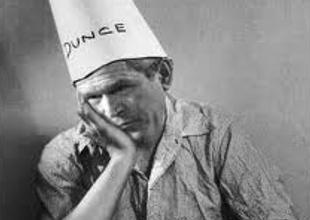
If you hang out much with thinking people, conversation eventually turns to the serious political and cultural questions of our times. Such as: How can the Americans remain so consistently brain-f**ked? Much of the world, including plenty of Americans, asks that question as they watch U.S. culture go down like a thrashing mastodon giving itself up to some Pleistocene tar pit.
One explanation might be the effect of 40 years of deep fried industrial chicken pulp, and 44 ounce Big Gulp soft drinks. Another might be pop culture, which is not culture at all of course, but marketing. Or we could blame it on digital autism: Ever watch commuter monkeys on the subway poking at digital devices, stroking the touch screen for hours on end? That wrinkled Neolithic brows above the squinting red eyes?
But a more reasonable explanation is that, (A) we don't even know we are doing it, and (B) we cling to institutions dedicated to making sure we never find out.
As William Edwards Deming famously demonstrated, no system can understand itself, and why it does what it does, including the American social system. Not knowing shit about why your society does what it makes for a pretty nasty case of existential unease. So we create institutions whose function is to pretend to know, which makes everyone feel better. Unfortunately, it also makes the savviest among us -- those elites who run the institutions -- very rich, or safe from the vicissitudes that buffet the rest of us.
Directly or indirectly, they understand that the real function of American social institutions is to justify, rationalize and hide the true purpose of cultural behavior from the lumpenproletariat, and to shape that behavior to the benefit of the institution's members. "Hey, they're a lump. Whaddya expect us to do?"
Doubting readers may consider America's health institutions, the insurance corporations, hospital chains, physicians' lobbies. Between them they have established a perfectly legal right to clip you and me for thousands of dollars at their own discretion. That we so rabidly defend their right to gouge us, given all the information available in the digital age, mystifies the world.
Petraeus Aide Marvin Hill: If Troops Can't Deal With DADT Repeal, They Should Leave The Service

WASHINGTON -- A senior aide to David Petraeus, commander of NATO forces in Afghanistan, is out with a strong statement in support of repealing Don't Ask, Don't Tell (DADT), saying that servicemembers who can't adjust to the change should think about leaving the military.
"If there are people who cannot deal with the change, then they're going to have to do what's best for their troops and best for the organization and best for the military service and exit the military service, so that we can move forward -- if that's the way that we have to go," said Command Sergeant Major Marvin Hill in an interview with Roland Martin on Washington Watch, set to air on Sunday.
Indeed, one of the arguments put forth by many critics of repeal is that integrating the forces will result in a loss of large number of servicemembers opposed to the change.
Joint Chiefs of Staff Chairman Adm. Mike Mullen addressed this concern during his recent testimony before the Senate Armed Services Committee, stating, "Should repeal occur, some soldiers and Marines may want separate shower facilities. Some may ask for different berthing. Some may even quit the service. We'll deal with that."
~ HuffPo
Sunday, December 5, 2010
All The President's Captors
THOSE desperate to decipher the baffling Obama presidency could do worse than consult an article titled “Understanding Stockholm Syndrome” in the online archive of The F.B.I. Law Enforcement Bulletin. It explains that hostage takers are most successful at winning a victim’s loyalty if they temper their brutality with a bogus show of kindness. Soon enough, the hostage will start concentrating on his captors’ “good side” and develop psychological characteristics to please them — “dependency; lack of initiative; and an inability to act, decide or think.”
This dynamic was acted out — yet again — in President Obama’s latest and perhaps most humiliating attempt to placate his Republican captors in Washington. No sooner did he invite the G.O.P.’s Congressional leaders to a post-election White House summit meeting than they countered his hospitality with a slap — postponing the date for two weeks because of “scheduling conflicts.” But they were kind enough to reschedule, and that was enough to get Obama to concentrate once more on his captors’ “good side.”
And so, as the big bipartisan event finally arrived last week, he handed them an unexpected gift, a freeze on federal salaries. Then he made a hostage video hailing the White House meeting as “a sincere effort on the part of everybody involved to actually commit to work together.” Hardly had this staged effusion of happy talk been disseminated than we learned of Mitch McConnell’s letter vowing to hold not just the president but the entire government hostage by blocking all legislation until the Bush-era tax cuts were extended for the top 2 percent of American households.
The captors will win this battle, if they haven’t already by the time you read this, because Obama has seemingly surrendered his once-considerable abilities to act, decide or think.That pay freeze made as little sense intellectually as it did politically. It will save the government a scant $5 billion over two years and will actually cost the recovery at least as much, since much of that $5 billion would have been spent on goods and services by federal workers with an average yearly income of $75,000. By contrast, the extension of the Bush tax cuts to the $250,000-plus income bracket will add $80 billion to the deficit in two years, much of which will just be banked by the wealthier beneficiaries.
http://www.nytimes.com/2010/12/05/opinion/05rich.html?_r=1
Ezra Klein Asks: Why did the Democrats falter on the tax cuts?
This post by Greg Sargent contains some wise words on the psychology of the Democrats:
At risk of overgeneralizing, the problem isn't that Dems aren't capable of winning an argument. It's that they don't think they're capable of winning a protracted political standoff, even on an issue where the public is on their side, once Republicans start going on the attack. They seem to set their goal early on at salvaging a compromise, rather than going for the win. As a result, they tend to telegraph weakness at the outset, sending a clear message that they'll essentially give Republicans what they want as long as they can figure out a way to call it a compromise.
It's very important to realize how strong of a hand Democrats had -- and to some degree, have -- on the Bush tax cuts. Right or wrong, the Democrats' original position on this was that the tax cuts for income under $250,000 should be extended, and the tax cuts for income over $250,000 should expire. The public agrees: 49 percent share the Democrats' position, 14 percent want all the tax cuts to go, and 34 percent want to see all the tax cuts extended. Put another way, 63 percent of Americans don't want the tax cuts for the rich extended.
The GOP understood this just fine: Back in July, Rep. Dave Camp, then the ranking Republican on the House Ways and Means Committee,admitted that his party couldn't hold tax cuts for the middle class hostage in order to secure tax cuts for the rich. "I'll probably vote for it myself," he said of the Democrats' proposal. In September, John Boehner joined him. "If the only option I have is to vote for some of those tax reductions," he told Bob Schieffer, "I'll vote for it."
Democrats, it seemed, had won this one. They had the popular position, the president's veto pen and control of the Congress. But they simply refused to carry the ball over the goal line. Instead, they began negotiating with themselves, talking about millionaires' brackets and short-term extensions. Republicans noticed the Democrats' disarray and lost their fatalism: "Incoming House Majority Leader Eric Cantor (R-Va.) said on Bloomberg Television he was ready to instruct GOP members to vote down legislation Democrats plan to bring to the floor that would extend the expiring Bush-era tax cuts only for the middle class."
Now it looks like all the tax cuts will be extended, at least for the moment. But it's a baffling outcome. The structure of the situation favored -- and continues to favor -- the Democrats. No tax cuts pass without their support, and Republicans have previously admitted that their position isn't popular enough to prevail in a standoff. The only thing that's changed is that Republicans have realized Democrats aren't confident enough to enter a standoff. But it didn't have to be this way. Think back to early this week, when the president announced the federal pay freeze. "The hard truth is that getting this deficit under control is going to require broad sacrifice," he said. "And that sacrifice must be shared by the employees of the federal government." Here's what he could've said next:
It also must be shared by those among us who've prospered most in recent years. Even before the financial crisis, middle-class incomes had stagnated. But the incomes of the wealthiest Americans hadn't. Similarly, America's upper class has recovered from the crisis much quicker than the working class. There's nothing wrong with that: The country depends on the ingenuity and resourcefulness of its most successful citizens. But in a time of high deficits and belt tightening, it makes $700 billion in tax cuts that go solely to the top 2% an unreasonable expense. Those tax cuts were passed in a time of surplus, and now we're in a time of deficits. As our situation changes, so must our policy. I will veto any bill that extends those tax breaks.
He not only could've said it, he could've stuck to it. But he didn't. Instead, Jack Lew and Tim Geithner are now supposed to negotiate out a deal, and the White House will be blamed for the inevitable concessions and disappointments it includes. I'm not against deal-making, of course, and I've regularly defended the administration's pragmatic concessions. But there are times when you can get more at the negotiating table, and times when you can get more by declaring that there's simply nothing to negotiate. This was the latter.
Obama is neither weak nor stupid ... nor a progressive
A lot of people are wondering why President Obama keeps offering compromises and capitulations to the Republicans before negotiations have even begun. A lot of people are wondering why he appears to keep effectively unilaterally knee-capping himself. A lot of people accurately argue that it would be great optics at least to try to stand on principle, and it might even produce better policies. Some say he is weak. Some question his intelligence. Some do one or both in less than polite terms. But many are overlooking a possible alternate explanation. Many are overlooking an explanation that is hiding in plain sight.
President Obama is no fool. He's actually extremely smart. One need not recount the entire litany, but suffice to say that one doesn't become president of the Harvard Law Review, get invited to teach at the University of Chicago Law School, or compose on the fly a riveting Speech on Race that galvanizes much of the nation-- even many inclined to be critics-- unless one has a rare and assiduously honed intellect. The argument that President Obama is stupid fails at first thought.
A more common refrain is that President Obama is weak. That he gives in too easily and doesn't know how to fight. This argument sometimes lapses into terms that shouldn't be acceptable even to the harshest of the president's critics, but many believe the president either doesn't know how to or is unwilling to stand his ground. But this belief also doesn't hold up under scrutiny.
President Obama would not be where he is today if he was weak or timid. He has had to overcome a host of personal and structural hurdles, and to dare even to try to become this nation's first black president takes a level of courage and determination almost beyond comprehension. Every president takes risks, but President Obama challenged and defeated presumptions that even many of his strongest supporters had taken for granted. He prevailed because he is smart. He prevailed because he is tough. He prevailed because he is almost fearless.
So, why would a person of such intelligence make what seems to be so many foolish political decisions? Why does he appear not to come to understand the nature of his opposition? Why does he seem to get rolled on so many issues on so many occasions? Call it The Obama Paradox. Or realize that the answer may lie in the nature of the questions.
The Obama Paradox presumes that the president is a liberal or a progressive, and that he is ceding his principles based on faulty strategies or a disinclination to face confrontation. Many of the president's more ardent supporters also buy into this presumption, but rather than accept that the buck stops in the Oval Office, they concoct a series of ever more ridiculous rationalizations. It's always someone else's fault, and the blame usually falls on Congress, particularly the Republicans, the Conservadems, and the Blue Dogs. But it's time to consider the possibility that the problem lies with the presumption underlying all these questions and explanations. It's time to consider that the president accepts centrist and conservative policies because he himself is a centrist or conservative.
This does not mean that President Obama is a Republican, or anything close to a Republican. The Republican Party is not conservative, it is extremist. But as the Republican Party has drifted farther and farther to the fringe, much of the establishment Democratic Party has intrepidly moved into the ideological space the Republican Party abandoned. The Republicans lead this movement to the right, and the Democrats follow, taking the political center with them and leaving the traditional left ever more disenfranchised, disenchanted, and politically alienated. The problem with Barack Obama isn't that he is worse than establishment Village Democrats, the problem is that he is one of them. He didn't change Washington, but he is changing what some who consider themselves liberal or progressive are willing to tolerate, accept, and even support.
Nobody forced President Obama to escalate the war in Afghanistan. Nobody forced him to expand oil drilling in the Arctic rather than make the case that we need an emergency effort to end our addiction to all fossil fuels. Nobody forced him to have his Department of Justice ignore the Bush administration's criminality. Nobody forced him to continue secret renditions or a policy of denying suspected terrorists the human right of due process. Nobody forced him to order his DOJ to appeal court rulings that would have ended Don't Ask Don't Tell. Nobody forced him to open a discussion about the deficit which even puts Social Security and Medicare on the table when the economy desperately needed and needs more Keynesian stimulus. Nobody forced him to keep on Bush's Defense Secretary. Nobody forced him to hire a neoliberal economic team and ignore the traditional liberal economists who had been almost alone in predicting the economic collapse. None of these moves was forced on him by the Republicans or the Conservadems or the Blue Dogs.
It's conventional wisdom to believe that the president gave away the public option for which he had campaigned, while accepting the mandate he campaigned against, and again the arguments are largely about what he might have gotten had he tried. Or the optics of trying. But again the presumption is that he wanted to try. The same goes for the inadequate and ultimately politically disastrous stimulus package. But he himself later admitted that the public option hadn't ever been that important to him. And his political team, like his more passionate supporters, continually hyped every isolated cherry-picked uptick in economic data as proof that his stimulus plan wasn't so inadequate after all. Take it at face value. He thought the stimulus was enough. He didn't care that much about a public option. The agenda so desired by liberals and progressives just wasn't his agenda.
Last February, writing about the health care reform meltdown, Glenn Greenwald offered a theory:
The primary tactic in this game is Villain Rotation. They always have a handful of Democratic Senators announce that they will be the ones to deviate this time from the ostensible party position and impede success, but the designated Villain constantly shifts, so the Party itself can claim it supports these measures while an always-changing handful of their members invariably prevent it.
But it's worse than that. It's not only about creating a shifting cast of villains, it's about creating a consistent facade of false blame. Someone else has to be the bad guy. That on every single issue there are means of challenging, and sometimes thwarting, the bad guy can be debated and argued and ignored and otherwise muddled in consciousness. But the fights are never truly fought, and then the compromised policies are marketed as great successes, not as capitulations. Take that at face value. One doesn't attempt to celebrate when one is left unsatisfied, rather one wakes up the next day determined to fix what needs fixing. But there has been no such determination. Instead, there has been much marketing of these false successes.
The Republicans are a convenient foil. To anyone paying attention and not under the sway of the corporatist media, they would be almost an amusing carnival were they not so dangerous in that their destructiveness now has legitimate political currency. But they didn't force the president's hand. He pursued the policies as he chose to do, and he fought the fights he chose to fight. He and his team have mocked and disparaged his party's traditional base. That doesn't mean he is a Republican. It does indicate the degree to which he buys into what is now conventional thinking among Village Democrats. President Obama is not stupid and he is not weak. He is very smart and he is very courageous. He is pursuing the politics he is pursuing not because anyone is forcing him to, and not because he is being beaten at the political game. He is pursuing the politics he is pursuing because it is who he is.
Politicians are but political tools, and they are not the only political tools. They are only as useful as the agendas they are willing to pursue. We don't owe them our loyalty, they owe us theirs. There are other political tools, and there are means of organizing that transcend the elective political game. It's about the issues. Given the gravity of the stakes, we have to focus on the issues, without excuses, and in some cases without compromise. That means we have to accept some politicians when there are no immediate alternatives, and we have to try to push them to do better and to be better even when it is counter to their own political ideologies, but it also means we can't pretend they are something they are not; and it also means we have to create a climate where there will be better and legitimate alternatives.
Crashing the gates was but a first step. There are more gates to crash.
Who Bankrolls The Right Wing In America? I Know Who!
There’s just one element missing from (news reports about) America’s ostensibly spontaneous and leaderless populist uprising: the sugar daddies who are bankrolling it, and have been doing so since well before the “death panel” warm-up acts of last summer. Three heavy hitters rule. You’ve heard of one of them, Rupert Murdoch. The other two, the brothers David and Charles Koch, are even richer, with a combined wealth exceeded only by that of Bill Gates and Warren Buffett among Americans. But even those carrying the Kochs’ banner may not know who these brothers are.
Their self-interested and at times radical agendas, like Murdoch’s, go well beyond, and sometimes counter to, the interests of those who serve as spear carriers in the political pageants hawked on Fox News. The country will be in for quite a ride should these potentates gain power, and given the recession-battered electorate’s unchecked anger and the Obama White House’s unfocused political strategy, they might.
All three tycoons are the latest incarnation of what the historian Kim Phillips-Fein labeled “Invisible Hands” in her prescient 2009 book of that title: those corporate players who have financed the far right ever since the du Pont brothers spawned the American Liberty League in 1934 to bring down F.D.R. You can draw a straight line from the Liberty League’s crusade against the New Deal “socialism” of Social Security, the Securities and Exchange Commission and child labor laws to the John Birch Society-Barry Goldwater assault on J.F.K. and Medicare to the Koch-Murdoch-backed juggernaut against our “socialist” president.
Only the fat cats change — not their methods and not their pet bugaboos (taxes, corporate regulation, organized labor, and government “handouts” to the poor, unemployed, ill and elderly). Even the sources of their fortunes remain fairly constant. Koch Industries began with oil in the 1930s and now also spews an array of industrial products, from Dixie cups to Lycra, not unlike DuPont’s portfolio of paint and plastics. Sometimes the biological DNA persists as well. The Koch brothers’ father, Fred, was among the select group chosen to serve on the Birch Society’s top governing body. In a recorded 1963 speech that survives in a University of Michigan archive, he can be heard warning of “a takeover” of America in which Communists would “infiltrate the highest offices of government in the U.S. until the president is a Communist, unknown to the rest of us.” That rant could be delivered as is at any Tea Party rally today.
The Tea Party movement is remarkable in two respects. It is one of the biggest exercises in false consciousness the world has seen – and the biggest Astroturf operation in history. These accomplishments are closely related.
An Astroturf campaign is a fake grassroots movement: it purports to be a spontaneous uprising of concerned citizens, but in reality it is founded and funded by elite interests. Some Astroturf campaigns have no grassroots component at all. Others catalyse and direct real mobilisations. The Tea Party belongs in the second category. It is mostly composed of passionate, well-meaning people who think they are fighting elite power, unaware that they have been organised by the very interests they believe they are confronting. We now have powerful evidence that the movement was established and has been guided with the help of money from billionaires and big business. Much of this money, as well as much of the strategy and staffing, were provided by two brothers who run what they call "the biggest company you've never heard of".
Charles and David Koch own 84% of Koch Industries, the second-largest private company in the United States. It runs oil refineries, coal suppliers, chemical plants and logging firms, and turns over roughly $100bn a year; the brothers are each worth $21bn. The company has had to pay tens of millions of dollars in fines and settlements for oil and chemical spills and other industrial accidents. The Kochs want to pay less tax, keep more profits and be restrained by less regulation. Their challenge has been to persuade the people harmed by this agenda that it's good for them.
The Guardian UK
One Reason To Leave Texas
Texas has numerous problems, among them is an education system that is failing students, placing Texas towards the bottom in rankings of the various states of our Union. But, no problemo. Our guv'ner with the craggy face and purty hair is off on a national tour to demand that Texas gits that coveted power abused by southern states prior to the Civil War: "states' rights".
By spending time pushing the poorly thought-out tee bag agenda, our guv'ner with the craggy face and purty hair doesn't have to face Texas' real problems. And he can push his own unannounced but obvious desire to be elected (horrors) President of the USA.
WASHINGTON — Gov. Rick Perry's anti-Washington rhetoric, which helped hand him a re-election landslide, is about to be put to the test as he girds for a series of states' rights clashes with the federal government.
The Lone Star State governor's drive to gain more control of clean air regulations, Medicaid health coverage for the poor, immigration and border security will sharpen the national attention on Perry just as he becomes the new chairman of the Republican Governors Association.
With that, the ambitious 60-year-old West Texas politician is expected to fortify a coast-to-coast crusade against what he calls the long and oppressive reach of Uncle Sam.
"The timing is right," says University of Houston political scientist Jim Granato. "With the wind of the November elections at his back, Gov. Perry could sustain and even accelerate the (Republicans') current political momentum."
By galvanizing GOP governors, coordinating efforts with ascendant Republicans on Capitol Hill and barnstorming on behalf of his book, Fed Up! Our Fight to Save America from Washington, Perry hopes to foment a rebellion against federal regulation that could trigger the most sweeping devolution of federal powers to the states in decades.
"The governor has a great passion for freeing states from the one-size-fits-all mentality. He firmly believes that if you unleash the states you get good ideas for solving problems — not a magic wand, but good ideas," says Dave Carney, a veteran GOP political consultant and Perry confidante.
Anti-Washington 'games'
Texas Democrats, on the other hand, take umbrage.
"Perry employs his version of a states' rights campaign, which is to rail against the federal government while completely ignoring every state issue that really matters to Texas," said Anthony Gutierrez, a spokesman for the Texas Democratic Party. "Perry's anti-Washington political games have scored him political points but they've left Texas with struggling schools, children without health insurance and a battered environment."
Perry's coming offensive reflects the priorities of the tea party rebellion that resulted in significant GOP midterm election gains.
http://www.chron.com/disp/story.mpl/metropolitan/7324941.html
Tee Partay Funded By Wealthy Financiers
Thanks to the Supreme Court decision allowing unlimited campaign contributions by corporations and wealthy folks, incredible amounts were spent by wealthy financiers to defeat Democrat candidates who were working to stop the transfer of wealth from the Middle Class to the wealthy.
The newly created independent political groups known as super PACs, which raised and spent millions of dollars on last month's elections, drew much of their funding from private-equity partners and others in the financial industry, according to new financial disclosure reports.
The 72 super PACs, all formed this year, together spent $83.7 million on the election. The figures provide the best indication yet of the impact of recent Supreme Court decisions that opened the door for wealthy individuals and corporations to give unlimited contributions.
The financial disclosure reports also underscore the extent to which the flow of corporate money will be tied to political goals. Private-equity partners and hedge fund managers, for example, have a substantial stake in several issues before Congress, primarily the taxes they pay on their earnings.
More: http://www.washingtonpost.com/wp-dyn/content/article/2010/12/03/AR2010120306995.html?hpid=topnews
Thursday, December 2, 2010
Texas Tee Partay Voters In For A Shock!
In Texas, Medicaid is a vital health insurance coverage for kids of poor parents. Since Texas has been ruled by Republicans for a while, there are a lot of poor parents in Texas. Over 1.5 million kids depend upon Medicaid for their health and well being.
I'm hearing that there are well over a million poor elderly folks in nursing homes paid for by Medicaid. Since Texas has been ruled by Republicans for a while, there are a lot of poor elderly folks in Texas. Obviously, Texas has a whole lot of people depending upon Medicaid to remain alive!
Now, the TeaPublicans in Texas want to opt out of Medicaid. In fact, Jim Pitts, Waco TeaPublican said recently that "the state is studying Medicaid and other forms of government-run health care with the idea of getting out of it. A man in the audience mentioned a friend on the program and asked whether lawmakers would 'throw him out on the street.'”
"'If we did exactly what we’re doing today, we wouldn’t be throwing him out on the street,' Pitts answered. 'But if we have any savings on getting out of Medicaid, we will have to throw some people out in the street.'"
So now Tee Partayers who voted in these TeaPublican jerks will have to decide if it is their children, grammaw or grampaw, or their neighbor's children, grammaw or grampaw who gits thrown out in the street. Or, perhaps just throw 'em all out in the street. Might be a good way to git rid of all them pesky poor folks who don't deserve them tax cuts for the wealthy.
I'm betting that this is only the beginning of the TeaPublican madness. But it isn't my fault. I didn't vote for them idjits. You did!
Confederates Are Cool Again!
Are you fed up with the feds? Do you think that 1) Obama is a modern-day Abe Lincoln, and 2) that's a horrible thing?
Are you into celebrating eugenics your heritage, defending slavery your homeland, and denouncing the US Constitution unfair tariffs on your exports?
You might be a neo-Confederate! And brothers and sisters, do we have a club for you! Just in time for the 150th anniversary of the shots that started the Civil War, one longtime Southern—ahem—heritage society, the Sons of Confederate Veterans, is celebrating with a huge membership drive and a bevy of TV commercials...some of which had been airing on the History Channel. Until Monday, that is, when the History Channel figured their ads should probably reflect some basic understanding of, you know, history.
Now, Civil War revisionism is nothing new. For generations, Southern apologists have argued that the stars and bars and rebel gray are about "heritage," not hate; that the war was fought over "states' rights," not slavery. But the SCV's new ads are custom-tailored to our post-Obama tea party zeitgeist. The code words have changed from "states' rights" to "federal taxation." The war was "really about money and control," we learn, not long after hearing how the aggressive radical Abraham Lincoln had no qualms about throwing waves of Northern soldiers to their deaths to extract a tribute from the poor, put-upon men of Dixie who "stood courageously for liberty." Says the sing-songy female narrator who delivers these historical "truths":
Don't let others do your thinking for you! Don't allow them to rob you of your heritage while they celebrate their own! Be proud of your Southern history and heritage!
MotherJones
Wednesday, December 1, 2010
Blank Check For Banks, Zilch For The Unemployed
In Washington, the agenda has long since moved on from bailing out megabanks to figuring out how to stop paying for things that regular people need -- luxuries like health care, retirement benefits and unemployment insurance.
In the suburbs of Denver, Anthony Roebuck and his family find themselves confronting an action list that seems cruelly divorced from the proceedings in the nation's capital: They have to figure out how to keep the heat on through the Colorado winter now that his unemployment check has run out.
The latest extension of emergency unemployment benefits expired on Tuesday, as a dysfunctional Congress let the deadline go without striking a deal to keep the money flowing. That put Roebuck -- who drew his last check on Monday -- among the two million or so unemployed Americans facing the imminent loss of their benefits between now and the end of the year.
How could there have been so many billions for Wall Street, so much room to lower taxes for people with golf memberships and country houses, yet a $500-a-week check to help him pay the rent while he looks for another job suddenly threatens to bankrupt the nation?
The Constitution THEY Support Ain't OUR Constitution!
Hay, everybody, let's return to the bad ol' days when the most basic laws protecting workers, consumers, and other ordinary Americans were completely forbidden!
Modern-day tee bags are claiming that the federal child labor laws, social security, unemployment compensation, etc. violate the Constitution!
Modern-day tee bags are claiming that the federal child labor laws, social security, unemployment compensation, etc. violate the Constitution!
Recent tee bag Congressional 'Republican' candidate Joe Miller has stated that child labor, Social Security, unemployment compensation, etc. etc. should be decided upon by the individual states within their own borders. (Yeah, that stuff really worked in the past, eh?) He sez that 'activist judges' (meaning judges who don't agree with his constipated view of the Constitution) have violated their oaths of office or something by ruling that these programs he dislikes are Constitutional.
Rand Paul, in a series of television and radio interviews, suggested that the Civil Rights Act of 1964 was too broad and should not apply to private businesses, such as luncheonettes. Of course, he sez he'd never personally discriminate, but that it should be OK for bidnesses to do so if they want.
Numerous tee bags have stated that they would support repealing the 17th Amendment to the Constitution (which allows for the public to vote for their Senators). They say we'd all have more 'liberty' by losing the right to vote for our Senators! One of these tee bags is the Texas Idiot himself, Rep. Louie Gohmert (R-TX).
Well folks, you guys have voted in some real strange folks. In your haste to 'stick it' to Obama, you've actually 'stuck it' to yourselves. If these nutballz you voted in have their way, your liberties will disappear like smoke as the Constitution is rewritten to keep you subjugated to the will of - you guessed it - our 'betters', the top 1% who control the wealth of this Nation.
Resources:
http://www.nytimes.com/2010/05/21/us/politics/21paul.html?ref=politicshttp://thinkprogress.org/2010/10/18/raese-tenther/
http://networkedblogs.com/bhr08
Subscribe to:
Posts (Atom)